Thy Saints, O Lord, shall flourish like the lily, alleluia; and they shall be before Thee as the odor of balm, alleluia.
The dwelling of Saints is in heavenly kingdoms, alleluia, and their rest is everlasting alleluia.
Thy Saints, O Lord, cried out within the veil, alleluia, alleluia, alleluia.
O ye spirits and souls of the just, sing a hymn to our God, alleluia, alleluia.
The just will shine forth like the sun in the presence of god, alleluia.
Chapter: Wisdom 5.1
The just shall stand with great constancy against those that have afflicted them and have taken away their labors.
Short R: O ye holy and just ones, rejoice in the Lord, Alleluia, alleluia.
V: God hath chosen you unto Himself for an inheritance. Alleluia. Glory be to the Father....
(From Lauds in the Common of Apostles and Evangelists in Paschaltide, from the Monastic Diurnal)
Wednesday, April 06, 2005


Tuesday, April 05, 2005
pilgrims
This is incredible. Let me underscore that the authorities are expecting as many as four million pilgrims in Rome to see the Pope. Look at this picture. Ecce populus. This fills one with hope that perhaps the hordes are not quite as godless as one had thought. Its all wonderfully medieval. I do wish I could pick up and go to Rome just now.

the fructive power of death in christ
It has been amazing to see what the death of the Pope has birthed. Apparently they are expecting as many as four million pilgrims in Rome. Young people are coming from all over Europe -- indeed from all over the world -- staying in tents, standing in lines for hours and hours and hours. There are breathtaking pictures of thousands at a time slowly making their way into St. Peter's. The cable news networks have turned into twenty four hour a day mouthpieces for the Gospel. When CNN goes to commercial, they play things like John Paul saying "My hope and my prayer is that you will open your hearts to Christ." Last night Franklin Graham was on Larry King quoting from John: "I am the way, the truth, and the life. No one comes to the Father but by me." It is absolutely amazing.
And if this isn't a display of popular sentiment, I don't know what is. The Pope is being praised in equal measure by George W. Bush and Fidel Castro. All around the world, millions and millions of people are praying, and praising the good example of the most intense and public proclamation of Christ crucified from the last hundred years (I would say): the life and death of John Paul II. I can't say how excited I am about this conversion of the media, temporary though it doubtless is. But the potential for good is great, so to speak. This "media event" has the potential to reach millions more, and (let us pray) to change lives and convert hearts.

And if this isn't a display of popular sentiment, I don't know what is. The Pope is being praised in equal measure by George W. Bush and Fidel Castro. All around the world, millions and millions of people are praying, and praising the good example of the most intense and public proclamation of Christ crucified from the last hundred years (I would say): the life and death of John Paul II. I can't say how excited I am about this conversion of the media, temporary though it doubtless is. But the potential for good is great, so to speak. This "media event" has the potential to reach millions more, and (let us pray) to change lives and convert hearts.
Monday, April 04, 2005
john paul's message the day after his death
This comes from Zenit via Fr. Harmon.
Here is the message John Paul II had prepared to be read at the gathering of pilgrims to pray the Regina Caeli today, Divine Mercy Sunday. It was read by Archbishop Leonardo Sandri, substitute of the Vatican Secretariat of State, following the Mass for the eternal repose of John Paul II.
* * *
Dear Brothers and Sisters!
1. The joyful Easter Alleluia resounds also today. Today's Gospel page of St. John underlines that the Risen One, on the night of that day, appeared to the Apostles and "showed them his hands and his side" (John 20:20), that is, the signs of the painful Passion printed indelibly on his body also after his Resurrection. Those glorious wounds, which eight days later he made the incredulous Thomas touch, reveal the mercy of God "for God so loved the world that he gave his only Son" (John 3:16).
This mystery of love is at the heart of today's liturgy, Sunday "in Albis," dedicated to the worship of Divine Mercy.
2. To humanity, which at times seems to be lost and dominated by the power of evil, egoism and fear, the risen Lord offers as a gift his love that forgives, reconciles and reopens the spirit to hope. It is love that converts hearts and gives peace. How much need the world has to understand and accept Divine Mercy!
Lord, who with [your] Death and Resurrection reveal the love of the Father, we believe in you and with confidence repeat to you today: Jesus, I trust in you, have mercy on us and on the whole world.
3. The liturgical solemnity of the Annunciation, which we celebrate tomorrow, leads us to contemplate with Mary's eyes the enormous mystery of this merciful love that arises from Christ's heart. With her help, we can understand the true meaning of paschal joy, which is based on this certainty: The One whom the Virgin carried in her womb, who suffered and died for us, has truly risen. Alleluia!
the annunciation, transferred
Hail, O you who have become a kingly throne; hail, O you who carry Him who carries all! Hail, O Star who manifests the Sun, hail, O womb of the divine Incarnation! Hail, O you through whom creation is renewed; hail, O you through whom the Creator becomes a babe!

eulogizing the holy father
There have been lots of wonderful things said about Pope John Paul II in the days since his death. One of the most interesting and apt of them came from Archbishop Rowan Williams, who described John Paul's last days as a "lived sermon."
In the following, we are encouraged not to dwell on "the frailty of his last years" but on the vitality and action of his early pontificate. I think this is wrong. I think JP2's most powerful witness might well be the frailty of his last years, and particularly of his last days. Of course, we ought not to forget the vitality and action of his early pontificate, but the way he died spoke beautifully of the "culture of life" and was a moving witness to our Lord's passion and death. John Paul in his final days was like a sheep, which before its shearers is silent... quite literally silent, as John Paul apparently had great difficulty speaking as he died.
-------------
Pope John Paul II: His legacy for the church, and the world
John I. Jenkins and John Cavadini
The Boston Globe
Monday, April 4, 2005
NOTRE DAME, Indiana
Among the inspirations of the life of Pope John Paul II was his frequent
reference to the "civilization of love." It was an ideal that sparked the
imagination. Yet it was also a concept consistent with the example of his life
in a culture that is awash at times in cynicism, uncertainty and materialism.
He showed us how to live a life grounded in prayer, but also in reconciliation.
His outreach to the Jewish people, for example, was remarkable at a time in
history when ethnic divisions sometimes threatened the world on a broad level.
He spoke of a special relationship between the Jews and the Church and insisted
that the Old Covenant had never been revoked. His words put forth possibilities
for theologians that are yet to be fully explored.
In one special moment, the pope told an audience of Jews that he regarded them
as "our brothers and sisters in the Lord." Surely this was part of his vision
of a civilization of love.
And in a time when society seems to have lost its ear for the ideals of
procreation and their intrinsic connection to married love, the pope spoke of
the "nuptial meaning of the body" and upheld the values of Pope Paul VI's
controversial encyclical, "Humanae Vitae."
He worked to put the encyclical in a larger context. In his civilization of
love, the procreative ethic and an ethic of seamless love would reject the
negativity of abortion and the refusal of societies to guarantee the education
and health of all their children.
These were not popular views in parts of Western civilization, yet even critics
admired his fortitude and his recognition of heroic possibility in the
aspirations of humanity.
In a self-centered culture, this pope bore witness to service, to personal
sacrifice and the humanizing values rooted in love.
For some, the lives of the saints might seem old-fashioned and certainly a
private domain of the church. But in the pope's civilization of love they were
sources for healing cultures, because they represented the greatness of human
possibility. He once spoke of the way in which Catholic and non-Catholic
Christians died together in Uganda, referring to the "ecumenism of the saints
and of the martyrs," saying that the "communio sanctorum speaks louder than the
things that divide us."
Yes, in the words of the cliché, this pope was a Catholic. But he saw heroic
witness in any people who stood for goodness and hoped for the renewal of
civilization.
So John Paul II could speak in the conviction of the absolute, and hold to
tenets of Catholicism that rankled others, yet avoid triumphalism and
superiority, tendencies that would be blind to the courageous witness of
others. In this, he moved inexorably toward a civilization of love, inspiring
others, particularly young people, to lives of joy and hope.
We should not be focused on the frailty of his last years, but on the incredible
vitality that he brought to his mission during most of his tenure. He went
everywhere, not just centers of Catholicism, whether the American Midwest or a
former Soviet republic or Fidel Castro's Cuba. In his 26-year papacy, he made
more than 104 trips outside Italy, taking in 129 of the world's 191 independent
states. He held talks with more than 1,500 heads of state or government.
His great intellectuality, as expressed in the 14 encyclicals he wrote and 100
other major documents, was an infusion of energy to Catholic intellectual
thought, and he was a powerful influence for all of us at Catholic
universities.
For decades the impact of John Paul II's papacy will be discussed on these
campuses and throughout the world. What remains to be seen is whether his
civilization of love can be realized. It will be food for thought in these
coming days as he is remembered and his image crosses millions of television
screens once again.
The pope did not expect his bold vision to be achieved either quickly or
painlessly, but it begins in the hearts and souls of every one of us. John Paul
II believed in the power of ideals and simple human warmth to inspire a sense of
heroic possibility latent in all of us, Catholic and non-Catholic alike.
He was a gift to Catholics. He was a gift to the world.
(Rev. John I. Jenkins, C.S.C., is president-elect of the University of Notre
Dame. John Cavadini is chair of the theology department at Notre Dame.)
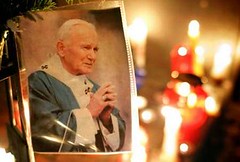
In the following, we are encouraged not to dwell on "the frailty of his last years" but on the vitality and action of his early pontificate. I think this is wrong. I think JP2's most powerful witness might well be the frailty of his last years, and particularly of his last days. Of course, we ought not to forget the vitality and action of his early pontificate, but the way he died spoke beautifully of the "culture of life" and was a moving witness to our Lord's passion and death. John Paul in his final days was like a sheep, which before its shearers is silent... quite literally silent, as John Paul apparently had great difficulty speaking as he died.
-------------
Pope John Paul II: His legacy for the church, and the world
John I. Jenkins and John Cavadini
The Boston Globe
Monday, April 4, 2005
NOTRE DAME, Indiana
Among the inspirations of the life of Pope John Paul II was his frequent
reference to the "civilization of love." It was an ideal that sparked the
imagination. Yet it was also a concept consistent with the example of his life
in a culture that is awash at times in cynicism, uncertainty and materialism.
He showed us how to live a life grounded in prayer, but also in reconciliation.
His outreach to the Jewish people, for example, was remarkable at a time in
history when ethnic divisions sometimes threatened the world on a broad level.
He spoke of a special relationship between the Jews and the Church and insisted
that the Old Covenant had never been revoked. His words put forth possibilities
for theologians that are yet to be fully explored.
In one special moment, the pope told an audience of Jews that he regarded them
as "our brothers and sisters in the Lord." Surely this was part of his vision
of a civilization of love.
And in a time when society seems to have lost its ear for the ideals of
procreation and their intrinsic connection to married love, the pope spoke of
the "nuptial meaning of the body" and upheld the values of Pope Paul VI's
controversial encyclical, "Humanae Vitae."
He worked to put the encyclical in a larger context. In his civilization of
love, the procreative ethic and an ethic of seamless love would reject the
negativity of abortion and the refusal of societies to guarantee the education
and health of all their children.
These were not popular views in parts of Western civilization, yet even critics
admired his fortitude and his recognition of heroic possibility in the
aspirations of humanity.
In a self-centered culture, this pope bore witness to service, to personal
sacrifice and the humanizing values rooted in love.
For some, the lives of the saints might seem old-fashioned and certainly a
private domain of the church. But in the pope's civilization of love they were
sources for healing cultures, because they represented the greatness of human
possibility. He once spoke of the way in which Catholic and non-Catholic
Christians died together in Uganda, referring to the "ecumenism of the saints
and of the martyrs," saying that the "communio sanctorum speaks louder than the
things that divide us."
Yes, in the words of the cliché, this pope was a Catholic. But he saw heroic
witness in any people who stood for goodness and hoped for the renewal of
civilization.
So John Paul II could speak in the conviction of the absolute, and hold to
tenets of Catholicism that rankled others, yet avoid triumphalism and
superiority, tendencies that would be blind to the courageous witness of
others. In this, he moved inexorably toward a civilization of love, inspiring
others, particularly young people, to lives of joy and hope.
We should not be focused on the frailty of his last years, but on the incredible
vitality that he brought to his mission during most of his tenure. He went
everywhere, not just centers of Catholicism, whether the American Midwest or a
former Soviet republic or Fidel Castro's Cuba. In his 26-year papacy, he made
more than 104 trips outside Italy, taking in 129 of the world's 191 independent
states. He held talks with more than 1,500 heads of state or government.
His great intellectuality, as expressed in the 14 encyclicals he wrote and 100
other major documents, was an infusion of energy to Catholic intellectual
thought, and he was a powerful influence for all of us at Catholic
universities.
For decades the impact of John Paul II's papacy will be discussed on these
campuses and throughout the world. What remains to be seen is whether his
civilization of love can be realized. It will be food for thought in these
coming days as he is remembered and his image crosses millions of television
screens once again.
The pope did not expect his bold vision to be achieved either quickly or
painlessly, but it begins in the hearts and souls of every one of us. John Paul
II believed in the power of ideals and simple human warmth to inspire a sense of
heroic possibility latent in all of us, Catholic and non-Catholic alike.
He was a gift to Catholics. He was a gift to the world.
(Rev. John I. Jenkins, C.S.C., is president-elect of the University of Notre
Dame. John Cavadini is chair of the theology department at Notre Dame.)
Saturday, April 02, 2005
christian death
The death of the pope is a good catalyst for reflecting on the meaning of Christian death in general. I commend to your attention the
"Catechism of the Catholic Church" (which JP2 was instrumental in producing). I commend it to you in general, and as a reference on the meaning of Christian death in particular:
Because of Christ, Christian death has a positive meaning: "For to me to live is Christ, and to die is gain." "The saying is sure: if we have died with him, we will also live with him." What is essentially new about Christian death is this: through Baptism, the Christian has already "died with Christ" sacramentally, in order to live a new life; and if we die in Christ's grace, physical death completes this "dying with Christ" and so completes our incorporation into him in his redeeming act:
"It is better for me to die in Christ Jesus than to reign over the ends of the earth. Him it is I seek -- who died for us. Him it is I desire -- who rose for us. I am on the point of giving birth.... Let me receive pure light; when I shall have arrived there, then shall I be a man." [from St. Ignatius of Antioch]
In death, God calls man to himself. Therefore the Christian can experience a desire for death like St. Paul's: "My desire is to depart and be with Christ." He can transform his own death into an act of obedience and love towards the Father, after the example of Christ:
"My earthly desire has been crucified;... there is living water in me, water that murmurs and says within me: come to the Father." [from St. Ignatius of Antioch]
"I want to see God and, in order to see him, I must die." [St. Teresa of Avila]
"I am not dying; I am entering life." [St. Therese of Lisieux]
-From CCC 1010-1011
john paul ii, requiescat in pace
Grant, Lord, that your servant may find his rest this day with all the saints in your love. Forgive him of his sins. Vouchsafe to him to hear the words "well done, good and faithful servant." At the end of time, deliver him from judgment and raise him to glory, for the sake of your only Son, our Savior Jesus Christ, who died for the sins of John Paul and all the world on the + Cross, and who reigns with you and the Holy Ghost, now and forever. Amen.

Friday, April 01, 2005
a book review
This from one of my seminary's periodicals:
Review: Queer Commentary
Ken Stone, editor, Queer Commentary and the Hebrew Bible, The Pilgrim Press, 2001, paperback, ISBN 0829814477, $28.00.
Reviewed by Alicia Brooks
Queer Commentary and the Hebrew Bible, a collection edited by Ken Stone, is a welcome addition to scholarship on sexuality and scripture. in this volume, Stone and his contributors forego the weel-worn question of whether or not the Bible permits homosexuality. Instead, they unapologetically explore hte possibilities of queer theory as a tool for scriptural interpretation.
In this excellent introduction, Stone concisely surveys the history adn definistion(s) of "queer theory," highlighting foundational works as well as key debates within the field. He also addresses the history and politics of biblical commentaries and recent developments in the field of biblical studies. Stone does a thorough job of addressing potential knowledge gaps in his two main audiences: students of the Bible and students of queer theory. Both receive an accessible but sophisticated introduction to the less familiar field. Stone concludes his introduction by raising question about what it means to interpret scripture through the lens of queer theory, which the contributors take up in detail in their essays.
Seven essays, differing widely in style and subject matter, make up the body of the collection. Each delivers on the book's promise to be unapologetic, displaying boldness in both form and content. These authhors are not dabbling in queer theory; they dive in wholeheartedly.
Even the most "traditional" scholarly essays here exhibit the experimentation with form characteristic of queer theory. For example, several authors come out as queer within their essays, revealing personal experiences and / or motivations, which drew them to their subject matter. Many essays have provocative titles, such as Lori Rowlett's "Violent Femmes and S/M: Queering Samson and Delilah." Roland Boer and Timothy Koch make the farthest leaps in style and theme. Boer writes his essay as an imaginary (and racy) dialogue on the topic of sadomasochism, which takes place between YHWH, Moses, and secular thinkers such as Sigmund Freud and Jacques Lacan on top of Mount Sinai. Koch hilariously satirizes apologetic approaches to the Bible used to combat homophobia, such as "the 'Jesus is Love' Trump Card," before proposing his own "cruising" methodology for approaching scripture.
These essays feature many eyebrow-raising themes. One is the sexualiity of YHWH. In my favorite essay, Theodore Jennings explores the homoeroticism of YHWH's relationships with Saul and David, by drawing on Greek and Japanese texts about homosexual love between warriors. Another theme is the authority (or lack thereof) of scripture. In vastly different styles, Koch, Michael Cardin, and Mona West all argue for the authority of queer readers to make demands of scripture, adapting it to fit their experiences. Sadomasochism is a persistent theme, taken up in varying depths by Jennings, Boer, Rowlett, and Koch.
At times, the reader wonders whether these authors are pushing the envelope too far. Stone takes a step to answer this critique by concluding the book with three different responses to the book itself, a commentary within a commentary. Like Stone's introduction, these responses are as interesting as the essays themselves, and their inclusion gives the collection a moderating balance. Tat-Siong Bennew Liew discusses the give-and-take between Bilical studies and queer theory, observing that Biblical scholars use queer theory to pose questions to the bible, but seem reluctant to use the bible to pose questions to queer theory. Daniel Spencer analyzes the essays as examples of a liberationist hermeneutic, evaluating their potential impact on social justice struggles. Laurel Schneider raises insightful questions regarding gender issues within texts, debates about scriptural authority, and the role that the authors' desire for an affirming deity plays in their scriptural interpretations. In her response Scneider writes, "queer biblical theology... is an odd place of formation." Schneider's comment captures a sense that is evident throughout Queer Commentary and the Hebrew Bible that queer theory approaches to the Bible are in an early stage of development. Like an adolescent, these essays are at turns both tentative and reckless. The contributors are consciously experimenting, and they inevitably make mistakes. these mistakes may turn off some readers, particularly those who are already skeptical about queer theory as an approach to biblical interpretation. This is unfortunate. Even if one questions some of the interpretive moves in these essays, the book still raises important and interesting questions about interpretation itself. Despite its flaws, this collection proves that there is much fruitful work to be done by bringing queer theory into conversation with biblical studies. I hope that it will inspire future scholars to pursue that work.
pray for the pope
For those of you who have been living under the sea for the last 24 hours, John Paul II is gravely ill. It is likely that he will die soon. Pray for mercy. Pray for healing. Pray that he may be delivered from fear and be granted peace. When he dies, pray that his sins may be forgiven, and that he may be given a place in God's Kingdom, with all the saints.
Holy Mother of God, to whom John Paul has been consecrated, intercede for your Son's servant and vicar, that he may have life and peace. Amen.
Holy Mother of God, to whom John Paul has been consecrated, intercede for your Son's servant and vicar, that he may have life and peace. Amen.
Subscribe to:
Posts (Atom)
