 ...And [ECUSA] man said "Let us make God in our own image, after our likeness" ... So [ECUSA] man created God in his own image, in the image of [ECUSA] man created he him; male and female created he him.
Friday, March 17, 2006
the episcopal diocese of michigan
...And [ECUSA] man said "Let us make God in our own image, after our likeness" ... So [ECUSA] man created God in his own image, in the image of [ECUSA] man created he him; male and female created he him.


Thursday, March 16, 2006
in case you missed it...

Over at my favorite blog, there was a recent post about a friend of mine and his wife, who have done something pretty amazing. Hoozah Father Matthew and Janna! Hoozah MM for reporting it!
the terms of discourse
Here is what I have been doing today instead of school work. (Though actually, it bears pretty directly on my thesis.) Over at the Propaganda Box, J-Tron has started a very interesting discussion which he (a progressive) and I (a fuddy duddy) agree gets at the heart of the contemporary turmoil over human sexuality. Here is an enticing snipit. I hope I don't sound too didactic (though of course I think I am right):
Father WB says:
WB,
Father WB says:
“Gay and lesbian people are told that they are filled with sinful impulses, that they are in some way or another malformed, that their humanity is incomplete or disordered.”
That is exactly my position. But that is my position not just about gays and lesbians, but about EVERYONE. And I put myself at the top of the list [a list which has all of our names on it] of the (sexually) sinful, the malformed, the incomplete and the disordered.
Human love does not require sexual expression, otherwise celibates would be incapable of human love. And they’re not incapable. Ergo, etc.
What do you tell a gay or lesbian Christian who has forsaken sexual activity for the sake of the call of Christ that they discern in the Church’s moral strictures? That THEY are disordered? I have several friends who fall into this category, and they see their “equal treatment” in the Church as constitutive of their obedience to the Church’s call to a particular expression of continence, just like everyone else. Do they slip up? I don’t know. Probably. When they do, they should go to confession, just like everyone else.
I just don’t see why gay and lesbian Christians should get this special treatment. Why can’t the Church condone MY innate inclinations to sexual sin? Why is there no one lobbying for exemptions to the moral code conforming to MY sexual inclinations? Its not fair.
The incompleteness and disorder of all of humanity — of every human in his particularity — is a central element of the Christian devotional tradition. You cannot make sense of great swaths of Christian theology unless you admit that humanity (including gay and lesbian humanity) is in fact incomplete and disordered. And the primary locus of this incompleteness and disorder is the passions or the appetites — especially the sexual appetites. The fathers, East and West, are very clear and very consistent on this point.
This is why holy virginity is so prized by our tradition, from our Lord and St. Paul onward. It is only through ascetic struggle and openess to grace through prayer that Christians can attain the passionless serenity that is the material condition of deification.
The notion that the Church was not aware, historically, of our categories of sexual identity is the heart of the matter to me; and I balk at this notion. I.e. that we have something to teach the mind of Christ as it is enunciated in his Body (and that is the ONLY way it is enunciated in space and time). We don’t. We are called to total conformity to the mind of Christ, which of course includes conformity in terms of our notions of sexual identity. The Church is not called to submit her understanding of holiness to the terms of enlightenement or post-enlightenement sexual psychology.
The Church never had an understanding of LGBTQQ sexual identity because it does not admit of sexual identity at all. It admits of human identity in Christ on the one hand, and damnation (however it is construed) on the other hand. Men having sex with men has never been licit in the Church, whether homosexual men having sex with men or heterosexual men having sex with men. (Same with women.) The Church was not aware of those categories, as you say, so it could only forbid the sex, and not sex with reference to a sexual identity (of which it was not cognizant).
I balk at the inadequacy of the Tradition’s anthropology from your perspective. What the Church has sanctioned is the dichotomy of identity in Christ and identity not-in Christ. And the human activities (including sexual activities) that are consistent with each category have been exhaustively explicated. It seems very presumptuous to me for us to come along and say “Hold on a minute; you didn’t realize that there is actually homosexual identity in Christ, homosexual ideneity not-in Christ, and heterosexual identity in Christ, and heterosexual identity not-in Christ.”
I agree with GK-S on this point. You seem to be trying to force a particular essentialism on the Church, an essentialism around the axis of the location of the identity relation obtaining between a person and his / her sexuality, the exclusion of which essentialism is entailed by the Body of Christ’s inclusion of precisely (and exclusively) two natures: the divine and the human. We are invited to check the rest of our baggage, sexual or otherwise, at the door.
J-Tron says:WB,
Now we are getting somewhere! What you have written here drives at what I think is probably the crux of our disagreement and I want to consider it carefully before making a response.
The one thing I’d like to ask for clarification on, however, is this bit:
You seem to be trying to force a particular essentialism on the Church, an essentialism around the axis of the location of the identity relation obtaining between a person and his / her sexuality, the exclusion of which essentialism is entailed by the Body of Christ’s inclusion of precisely (and exclusively) two natures: the divine and the human.
I have read this sentence at least five times now and I still have no idea what you’re saying here. I’m a step away from trying to graph it out. I apologize for being so daft. Could you break this down into manageable chunks for my feeble brain?
Father WB says:JT —
I’m glad you appreciate it.
The “identity relation” in philosophy is that relation which every thing bears to itself. “Essentialism” is the science of essences, and in feminist theory (at least) has something to do with the philosophical idea that all of the properties a thing has, it has essentially. I.e. were it to lose one of those properties, it would cease to be that thing. For example, a triangle has, essentially, three sides. If some thing is a triangle, then that thing has three sides. Always and everywhere. If a triangle stops having three sides, it stops being a triangle.
Now, as far as I can tell, the common conceit in queer theory often called “sexual identity” is wrapped around the notion that a person’s sexuality is theirs essentially. If they lose that sexuality (for example, through brainwashing, or through some power structure’s forcing them to behave in ways counter to that sexuality, or forbidding them from behaving in ways consonant with that sexuality), then they cease to be who they are, essentially. And that is why, as far as I can tell, heternormativity is thought to be so insidious and destructive, because it chips away at the very identity of gays and lesbians, that relation they bear uniquely to themselves. It is corrosive of who they are.
But the Church doesn’t buy that. There are, we are told, two natures in the Body of Christ. He was perfect God and perfect human. And the Christian calling is a living-into that life — the life of the perfectly God and the perfectly human (in which there are no other essences or identities, Jew or Greek, male or female, slave or free - and in which there is no sexuality, no giving or being-given in marriage). This is life eschatologically perfected in Christ, a life toward which we are oriented on this side of eternity.
But serving the end of that (eternal) life in Christ, there is instituted a temporal life in the Body of Christ, in the Church. THIS life is an icon of THAT life, but is yet cognizant of the pull not only of sin, but of finitude as well and is instituted precisely for our transcendence of this life (as Wittgenstein put it, the ladder is thrown away once it has been ascended). And the sacramental and devotional life of the Body of Christ with its two natures, human and divine, sanctions a pattern of living that serves the transcendence of this (merely human) life, with all its myriad false identities, all its malformations, incompletions, and distortions (as you put it), and which serves our union with Christ, who is the perfection of human essence by being united to divine essence, perfectly formed, complete, undistorted.
And this temporal life, mystically within the the Body of Christ with its dual natures (or essences), is the content of the radicality of orthodoxy. Because it seeks dispassionate serenity, and “detachment from the world.” It holds up such things as celibacy, poverty, slavery, and death, as the avenues to intimacy, riches, freedom, and life.
The Church has instituted certain patterns of behavior that look forward to their own being-transcended, but which in the meantime are conduits through which we are elevated by degrees above our sin, above our passions, above our finitude, elevated to union with Christ. Eucharist looks forward to the transcendence of itself in the marriage supper of the Lamb, and in the meantime bears the grace of that eternal marriage supper to us in time and among our passions. Confession looks forward to the transcendence of itself in our moral perfection and eternal passionless serenity, and in the meantime imparts the grace of moral perfection to us in the very midst of our imperfection. Marriage looks forward to our subsumption in the consummation of Christ and his Bride, in which subsumption we do not marry. And the finite and provisional difference between male and female is sanctified as an icon of the paradoxical union between the eternally different human and divine natures in the person of Christ, and is a conduit of that eternal grace into our temporality.
But the Church sanctions THIS pattern of life and no other. And our conformity to this pattern of life, we are assured, leads to the transcendence of finite life altogether. It leads, in other words, to eternal life in union with Christ, the perfection of human nature in a gracious union with God. This is characterized as passionless serenity, or eternal contemplation. If we augment or change this pattern of life to accomodate our passions, we are going off on our own, back into our human nature apart from Christ.
To suggest that the Tradition has missed something in its consideratio of human nature (e.g. that the Tradition was not cognizant of LGBTQQ identity), is tantamount to suggesting that God has made a grammatical mistake: either in the language of creation, or (more probably) in the liturgical language he has revealed in the Body of Christ. It is like saying “You forgot to sanctify THIS!” No. There are no grammatical mistakes. There are no fissures in the surface. In the Incarnation of the Word, human nature, in every modality, was [is] united to divine nature in the person of Jesus, and an iconic, gracious, and singular pattern of life was divinely instituted among humanity that is fully capable of imparting salvation. Nothing was missed. No emendations are necessary. The grammar is impeccable, because it is the grammar of the eternal Word. The life is perfect, because it is Christ’s.
Monday, March 13, 2006
the libertine

Last night I went to see The Libertine, a chronicle of the life of John Wilmot, the second Earl of Rochester, a Restoration poet, wit, rake, courtier to Charles II, and notorious atheist. The movie was to my mind a very subtle and articulate metaphorical account (apology? critique?) of contemporary art and intellectualism. It stars Johnny Depp as John Wilmot, John Malkovich as (an excellent) Charles II, Samantha Morton as Elizabeth Barry, and Rosamund Pike as Elizabeth Malet.
The film shows, I think, the groundwork for the late shift toward "the interesting" as the primary category of aesthetic evaluation. Wilmot remarks, through the enactment of a little parable early on in the film that any "experience of interest will be carved out at your own expense." And this seems an apt moral for the film's Wilmot, though overall the film leaves it somewhat ambiguous as to whether it ought to be regarded as a critique of this notion, or an apology for it. I tend to think the latter, as after Wilmot's grotesque and syphalitic death at the age of 33 (wink, wink) in the film -- during the course of which death he mocks a priest by having him recite the Suffering Servant Song of Isaiah 53 -- Wilmot is resurrected for an epilogue aside, explaining his own death as a travesty of redemption, in which he was shown "our suffering Lord" and at the sight of him, climbed up the cross and took the nails for his own palms. All, presumably, in the service of "the interesting."
Echoes of Nietzsche and (perhaps) of Heidegger, though I am quite certain I do not understand the latter. It is all a very helpful and trenchant critique of idolatrous Christianity, after the manner of Kierkegaard, but the conclusions it draws are as horrific as the syphilis that ate up both Wilmot and Nietzsche. That is to say, when culture has been evacuated of any fundamental significance, the best one can do is to create something amusing. And the inevitable suffering of the artist is in proportion to the greatness of his art. This is Kierkegaard's category of the Aesthetic. The Kierkegaardian Aesthete can have, for example, no real friends, as real friendship always ceases merely to amuse, and he is merely after amusement. But praise God for the teleological suspension of the Aesthetic (and of the Ethical) into the Religious. And one is reminded in The Libertine of the relative closeness of the aestetical and the religious, despite the interposition of the ethical between them. E.g. Isaiah 53 DOES, in fact, apply remarkably well to Wilmot. But in the end he dies horribly, his only resurrection that of a dramatic aside in the film's epilogue.
The Libertine is very advisedly rated R for some violence, and loads of lurid sexual language and imagery. But like the film's cinematoraphy and music (both excellent, by the way), the lurid sexuality is saved from gratuitousness by its fittingness within the context of the film's moral (or of Wilmot's moral, depending on whether the film is ironical).
I give it four stars, two thumbs up, &c. But my addulations come with caution about the sexual content. Be aware.
Wednesday, March 08, 2006
yet something else i have in common with the pope
In addition to being staunch opponents of heresy and schism, the Holy Father and I are also both proud owners of ipods, though his is a 2 gb Nano, and mine is the 60 gb large one. Apparently, our ipods are even loaded with some of the same stuff.
Tuesday, March 07, 2006
let's particularize

Just to illustrate that I am fully blogger AND fully man, here is a picture of the place where all my thinking / blogging / writing happens. Or doesn't happen, depending on the day.
I often find it very interesting to see personal stuff from other people I only know through the mediation of the internet (and our Lord, of course). So I thought some of you might find it interesting to see a picture of my desk. Here it is.
Maybe not. Its up to you. What does your desk look like? Blog it!
st. athanasius

Because I am reading Athanasius right now, here is a pertinent quote:
He accepted and bore upon the cross a death inflicted by others, and those others His special enemies, a death which to them was supremely terrible and by no means to be faced; and He did this in order that, by destroying even this death, He might Himself be believed to be the Life, and the power of death be recognised as finally annulled. A marvellous and mighty paradox has thus occured, for the death which they thought to inflict on Him as dishonour and disgrace has become the glorious monument to death's defeat. Therefore it is also, that he neither endured the death of John, who was beheaded, nor was He sawn asunder, like Isaiah: even in death He preserved his body whole and undivided, so that there should be no excuse hereafter for those who would divide the Church.
-On the Incarnation, Chapter IV
Thursday, March 02, 2006
great lenten link collections
 The CaNN Blog has a great huge link list. Loads of helpful stuff.
Also try Lent and Beyond. A terrific blog, which is really kicking into high gear again this year during Lent. See especially the All Lenten Posts section to make sure you don't miss anything.
But while all this stuff is helpful, I've noticed a tendancy in my own devotional life to collect around myself the accoutrements of devotion (prayer books, rosaries, icons, etc.) as a substitute for actual devotion. So read, read, read. Explore the Christian blogosphere, which really seems to ripen during Lent. But don't forget to get on with the business of Retirement, Prayer, Fasting, Repentance, and Almsgiving.
"Therefore, my beloved, as you have always obeyed, so now, not only as in my presence, but much more in my absence, work out your own salvation with fear and trembling, for God is at work in you, both to will and to work for his good pleasure. do all things without grumbling or questioning, that you may be blameless and innocent, children of God without blemish in the midst of a crooked and perverse generation, among whom you shine as lights in the world, holding fast the word of life..."
(Philippians 2)
keeping a holy lent -- part ii: practice
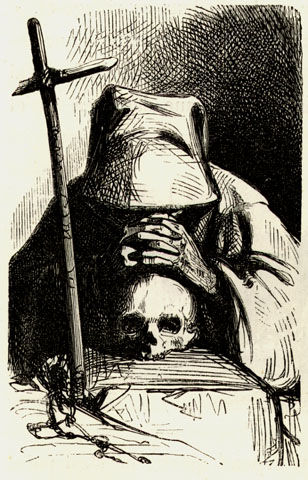
Lent is for the purpose of our growth in grace and in the knowledge of the Lord Jesus (2 Peter 3.18). Always keep this in mind. Lent isn’t about the disciplines. The disciplines serve the end of intimacy and communion with the Lord. The discipline is about driving the detritus of sin and distraction out of your heart and thereby making room for grace. So don’t forget that the whole point of Lent is growing in grace and knowledge of the Lord.
There are traditionally five Lenten tools for growing in grace and knowledge of the Lord:
1) Retirement
2) Prayer
3) Fasting
4) Repentance
5) Almsgiving
Retirement serves prayer. Go into your closet and shut the door and pray in secret (Matthew 6.6). It may seem silly even to mention, but nevertheless: it is a great help actually to remember to set aside time every day, preferably in the morning and in the evening, to be by yourself with God. This means going into your bedroom, or some place where you can be undisturbed and alone, closing the door, and praying.
Fasting, again, serves the end of growth in knowledge and love of the Lord. Let’s be honest: one aspect of life in time and space, an aspect, in other words, of being a human in the world, is that we are surrounded by all kinds of other created things. And those things are not bad. We don’t need to go far in the world, though, before we run into trouble. We are after growing in knowledge of the Lord. But we humans get easily overwhelmed by STUFF. And knowledge of STUFF can (and does) distract us from knowledge of the Creator of Stuff. Because our intellects are finite, we cannot hold everything there at once. And the danger is that we forget God by constantly remembering this and that. This is what St. Paul was talking about when he said of those whose minds became darkened that they changed the truth about God into a lie and served the creature rather than the creator (Romans 1.25). The great danger is that we become so attached to the STUFF around us that it becomes our master and our god. Then we are no better than pagan idolaters.
The provenance of idolatry is not pagan antiquity. It is life in space and time. Idolatry is just as much a danger to the 21st century Christian. And this is the point of fasting. We force STUFF out of our lives (whether it be food or television or whatever), and thereby create a space in our consciousness for the grace of God. Let’s face it: while you are gratifying your appetite (whether it be by eating another donut or by watching MTV), you are not praying. That’s a fact.
Repentance is our acknowledgement before God of the above facts: that we HAVE forgotten him, over and over and over again. And one of the chief avenues of our forgetfulness of him is the gratifying of our sinful appetites. We serve the creature rather than the creator, and we do it over and over again, every day, year in, year out. And the fact that our very existence in this world is geared toward this forgetfulness, that the deck is stacked against us because we are surrounded by so many tantalizing distractions, and in some cases we are even genetically predisposed to acquiesce to them (think of alcoholism) -- this fact is original sin: those things about the world which, through no fault of our own, nevertheless seek to trap us and mire us down in sin. This is the fallenness of the world, and we sin without even realizing it. So once we have fasted, forced some particular attachment out of our lives and out of our consciousness, and once we have gone into our room and shut the door, and once we have spoken to God in prayer, it is time to acknowledge our situation to him. This is repentance. To come to God on his own terms, to acknowledge what he knows too well: quia peccavi, that I have sinned.
Almsgiving is about our being not merely a repository of God’s grace, but also its conduit. Think in this regard of the Blessed Virgin. She was indeed “full of grace” (Luke 1.28). But though the grace of God most certainly flowed into Mary it did not merely pool up inside of her. It was not just for her benefit. It was given to her and stayed with her in an intimate and exclusive way for nine months, but then (O then!) it issued forth from her. Then it was given to the world in the most ecstatic and total way. The grace of God flowed through Mary; and some thirty-three years after flowing through her, it was poured out utterly for the sins of the whole world (1 John 2.2).
So once you have made a space in your heart for God’s grace, through retirement, prayer, fasting, and repentance, do something for others. Share something of what God has given you -- and he has given you everything you have -- with your fellow creatures, that they might come to grow in grace and the knowledge of the Lord as you have -- and you have.
benedict no longer 'patriarch of the west'?

The is from Shrine of the Holy Whapping, quoting Vatican Watcher.
...the task to consider for the future will be to distinguish again and more clearly between the proper function of the successor of Peter and the patriarchal office and, where necessary, to create new patriarchates and to detach them from the Latin church.It seems that Benedict is dropping the traditional papal title "Patriarch of the West," with a view to shifting the Church in the West towards a more Eastern model of more local autonomy.
The Shrine cites one of the chief benefits of this move:
It will make the structure of the current Latin Church much more like that of the Eastern Church, with various regional centers of authority. This will ease Eastern Orthodox concerns that the Papacy, by nature, desires to usurp those functions proper to patriarchs, promoting the possibility for East-West unity. (It also indicates a change of attitude which would ease the creation of an Anglican Rite.)Hoozah! That would be terrific. One only hopes that they will speed things along, rather than running on the more typical, ecclesiastico-geological time-frame. And of course they would need to guard against the tendency that lays the Orthodox open to the perennial charge that theirs is an "ethnic" Church. I.e. if there were more local patriarchates in the West, they would need to ensure that they not be distinguished merely by ethnicity. Balancing this with a geographical distinction would be challenging.
At any rate, it sounds hopeful.
Subscribe to:
Posts (Atom)
