Monday, February 12, 2007

prudentes sicut serpentes

Behold, I send you forth as sheep in the midst of wolves: be ye therefore wise as serpents, and harmless as doves. Matthew 10:16

My mother just drew to my attention this piece in the NYT. It concerns Christian scientists (big C, little S), specifically of the evangelical stripe, who must navigate "secular" academia.

Asked whether it was intellectually honest to write a dissertation so at odds with his religious views, [Dr. Ross] said: “I was working within a particular paradigm of earth history. I accepted that philosophy of science for the purpose of working with the people” at Rhode Island.

And though his dissertation repeatedly described events as occurring tens of millions of years ago, Dr. Ross added, “I did not imply or deny any endorsement of the dates.”

This raises some pretty interesting issues, pressing ones, even, but does so in a fatuous way. In the above quote, the very use of a particular methodology for dating in a dissertation does imply endorsement of it and its associated ideas. This is all part of the carefully constructed and troubling "myth of objectivity" which haunts academia in two ways: First there is the denial of any sort of objectivity—although I am sure this is less emphatic in the "hard" sciences, than it is in the "soft" sciences and humanities. Secondly there is the preservation of the form of objectivity that academics (self included) use to protect themselves from criticism by their peers. This is apparent in the dense fabric of language academics weave to avoid making any definitive or conclusive statements about anything. This has its advantages, of course. It allows one to keep a particular issue open to reconsideration, but usually it masks a definitive conclusion in an apparently innocuous way: it's the ultimate wolf in sheep's clothing.

I see this regularly in the use of what we like to call "theory" which gives our ideas a pleasantly reassuring scientific and objective-sounding ring, but in reality is the artificial "naturalizing" (that is, to understand something unreal as real) of perversion. It's particularly rife among people who like to extend psychoanalysis (the world's most tragic hoax) or Marxist economic theories (the second most) into other fields, in my case, ars historiae. Don't misunderstand: These people do so usually with the best of intentions, but as is the case in the NYT article, they seldom realize how deeply prejudiced they are against contradictions to their theoretical framework. They already do not recognize it to be a theory, which by definition is something that is still waiting conclusive proof.

For the conscientious Christian (a redundancy, I know), is it (1) possible to set aside one's "personal convictions" to engage other, even anti-Christian ideas? (2) Is to do so dishonest, or worse, immoral? (1) Yes; and (2) I don't believe so. In the case of the evangelical scientist, I imagine the solution is easiest, since the scientific method operates as a control over their results: it partially relieves them of responsibility for their conclusions. If they disagree with their conclusions, they probably should be exta conscientious to demonstrate the limits of their measuring devices and thereby cast doubt on them. Frankly, this doesn't matter to me very much, since if the earth is 10 billion years old or six thousand, it intersects my life in such a liminal way. (Creationism is maybe a separate issue, but I'm not sure I have a problem with the concept of a guided evolutionary process. It accords with God's deliberate pattern of mediated interaction with the created order.)

But more importantly, I believe we as Christians should strive to reinstate the desire for objectivity, even if, this side of the escahton, it is unobtainable. My reading of René Girard (more on this soon) has left me convinced that Christ's mission was ultimately one of revelation, truth, light, and objectivity. To aspire to be Christ-like is to pursue this objectivity, and this can mean in some cases being willing to shed our "personal convictions" many of which may be preventing us from attaining that goal (and to say this I am in no way discounting Christ's mission of redemption: what is sin if not falsehood, and who is Satan but a "liar and the father of lies"?). This also may mean, for those of us (like me) who find themselves constrained by the limits of a non-Christian intellectual framework, temporarily submitting to it. Or, more hopefully, being as "wise as serpents," finding ways to secrete the Gospel into our studies and academic output so as to subtly transform the perspectives of our colleagues and students and thus prepare the ground for the reception of the Gospel. Not all evangelism happens on the street corner with a sandwich board and a bundle of tracts.*

And finally, there is an extent to which the parsing of a "Christian" view of things, e.g. Creationism versus evolutionism, ultimately inhibits and counteracts the Gospel mandate. As I read this morning in St. Paul's first epistle to my namesake:

As I urged you when I was going to Macedonia, remain at Ephesus that you may charge certain persons not to teach any different doctrine, nor to occupy themselves with myths and endless genealogies which promote speculations rather than the divine training that is in faith; whereas the aim of our charge is love that issue from a pure heart and a good conscience and sincere faith. Certain persons by swerving from these have wandered away into vain discussion, desiring to be teachers of the law, without understanding either what they are saying or the things about which they make assertions. I Timothy 1:3-7.

________________
* I certainly hope that I am able to manage this. The dissertation that I hope to write would try to blow the lid off these issues as they pertain to art history, but it may be too clear of an affront to my PhD committee, so I am not entertaining great hopes.

the primates' meeting


The Primates' Meeting is getting underway at Dar es Salaam. I invite you all to pray. Priests, I would encourage you to offer your Daily Office and Mass (if you offer mass daily) with special intentions for the Primates, that they would all be given wisdom, humility, zeal for the catholic faith, and above all charity.

Because he happens to be the Archbishop of Canterbury at this moment in history, an enormous weight is being borne by Rowan Williams. I would invite you to pray for him particularly. Arguably, he bears more responsibility for the fate of Anglicanism than any other single person - maybe since Elizabeth I or Thomas Cranmer. I would not have his job for all the tea in China, and I can only imagine how burdensome this responsibility must be for him. Pray for him.

Also don't neglect to pray for Katharine Schori, the Presiding Bishop of the Episcopal Church. She leads the province which, by its actions and impenitence, has brought the Communion to the brink of dissolution. Pray that she would be especially blessed with the grace of humility, true contrition, and wisdom.

Lent and Beyond has terrific resources to guide your prayer.

Stand Firm is shaping up to have the best, or at least the most extensive and up-to-date news coverage. (Probably the best too.) It looks like they will be doing daily video blogging. My! The Anglican blogosphere is certainly getting technologically advanced.

And speaking of "vlogging" and so forth, don't forget to check out Anglican TV. Kevin has gone to Tanzania and will be posting videos. If you donate to Anglican TV (even a dollar), I think you can get on their special secret list for extra videos or something. Its not clear to me what exactly you get by donating (or whether it might actually be too late), but I believe you get some special access to extra video coverage or something.

Lastly, I would commend the Blessed Virgin as a very suitable prayer partner for each of you. Her humility and wisdom is the antidote to Episcopalian arrogance and foolishness. When she was presented with a choice that would have enormous consequences for the whole world, she responded "Be it done to me according to thy word." In consequence of her humility, Almighty God has magnified her, and all generations call her Blessed (Luke 1.46ff).

Saint Mary, full of grace, exalted pattern of humility and Seat of Wisdom, pray for us sinners! Show unto us the blessed fruit of thy womb!

Sunday, February 11, 2007

an intriguing interview with +tom wright, the bishop of durham

Read it all here. I am a little behind with this. Its been reported much elsewhere. This was an especially interesting bit with reference to Canon Kearon's expressed frustration with Archbishop Williams doing the right thing. Bishop Wright says:

"For Kenneth Kearon to accuse Rowan Williams of fostering schism is quite extraordinary. That is like someone in a house that is on fire accusing the firemen of ruining the book collection because they have sprayed water on it. It is quite clear that the split is coming from those in the American church who are insisting on doing something that the Lambeth Conference and the rest of the Communion had asked them not to do. To accuse Rowan Williams of fomenting schism is really projecting onto Rowan the schismatic actions which happened in 2003 when the Americans first gave acquiesence to Gene Robinson at their General Convention and then went ahead and consecrated him. In October 2003, the Primates said clearly that if this action goes ahead it will tear the fabric of the communion at its deepest level. The Americans went ahead and did it. All that has happened subsequently is the rest of the Communion saying we really hope you did not mean that but if you did, have you thought through the consequences? There are many in America who are trying to have their cake and eat it, who are doing the schismatic thing and then accusing those who object of being schismatic. That is the bizarre thing."


And finally, there is this trenchantness:

"Part of the difficulty is that there is a myth about in some circles that historic Anglicanism has no particular doctrine and is just a matter of worshipping together and believing what you like. If you go back to the 16th and 17th centuriesm who will find them arguing in great detail over the Articles of Religion which became the Thirty-Nine Articles. They were hugely important. The idea of doctrinal indifferentism is a very recent idea which has sprung up in some parts of America."

Saturday, February 10, 2007

alexei khomiakov on anglicanism and private judgment: and some thoughts-out-loud: what is catholicity? or: quo enim recedam?

Many bishops and divines of your communion are and have been quite orthodox. But what of it? Their opinion is only an individual opinion, it is not the Faith of the Community. Ussher is almost a complete Calvinist; but yet he, no less than those bishops who give expression to Orthodox convictions, belongs to the Anglican Church. We may, and do, sympathise with the individuals; we cannot and dare not sympathise with a community which interpolates the Symbol and doubts her right to that interpolation, or which gives communion to those who declare the Bread and Wine of the High Sacrifice to be mere bread and wine, as well as to those who declare it to be the Body and Blood of Christ. This for an example — and I could find hundreds more — but I go further. Suppose an impossibility — suppose all the Anglicans be quite orthodox; suppose their Creed and Faith quite concordant with ours; the mode and process by which that creed is or has been attained is a Protestant one; a simple logical act of the understanding, by which the tradition and writings of the Fathers have been distilled to something very near Truth. If we admit this, all is lost, and Rationalism is the supreme judge of every question. Protestantism, most reverend sir, is the admission of an unknown [quantity] to be sought by reason; and that unknown [quantity] changes the whole equation to an unknown quantity, even though every other datum be as clear and as positive as possible. Do not, I pray, nourish the hope of finding Christian truth without stepping out of the former Protestant circle. It is an illogical hope; it is a remnant of that pride which thought itself able and wished to judge and decide by itself without the Spiritual Communion of heavenly grace and Christian love. Were you to find all the truth, you would have found nothing; for we alone can give you that without which all would be vain — the assurance of truth.


From Mind in the Heart, via Restorative Theology, via Pontifications.

Okay. I take his point, in a sense. However: were I (or anyone else) to convert to a non-Protestant (in the way Khomiakov seems to be using that term) church, would not "rationalism" still be sitting in judgment over catholic doctrine? Would not the "mode and process by which" this convert attained a catholic creed yet be "a protestant one; a simple logical act of the understanding, by which the tradition and writings of the Fathers have been distilled..."? Would not Rationalism, or better perhaps would not rationality, or the reason, yet be "the supreme judge of every question" in such a case? In other words, is it not in fact the case that converts convert because the doctrine of the ecclesial entity to which they are converting makes sense to them? Concomitantly, then, is not their reason the arbiter of (Scripture and) Holy Tradition? Khomiakov finds in Anglicanism "a remnant of that pride which thought itself able and wished to judge and decide by itself without the Spiritual Communion of heavenly grace and Christian love." But here, precisely, is the paradox: does not the act and possibility of conversion, which surely Khomiakov admits, entail the very possibility of that which he here denies: namely that an individual outside the Spiritual Communion of heavenly grace and Christian love (which is the Church) may "judge and decide" rightly, by an inscrutable process of intellection and affection, that catholic doctrine is true and therefore ought to be assented to? And once he has converted, does not the Roman Catholic or Orthodox Christian, by the quotidian renewal of his resolve to remain within the Roman or Orthodox communion, just continually ratify the sovereignty of his reason as the arbiter of truth?

This question is related to that paradox raised by Augustine in the narration of his own conversion, a paradox which my intuition tells me has its roots in Platonism and also has to do with prevenient grace: how can you call God to help you when his help is necessary for you even to call out? Augustine also puts it another way, in terms of exteriority and interiority: how can you seek something (or Someone) that is already and has always been inside of you? Quo enim recedam extra caelum et terram, ut inde in me veniat Deus meus, qui dixit, caelum et terram ego impleo? Loosely: Where might I withdraw beyond heaven and earth that my God might come into me, when my God has said "I fill heaven and earth"?

In the excerpt from Khomiakov we see an assumption regarding the differentiation of Protestantism from Catholicism. And I here mean both of these terms in the kind of way that they are often used, for example, at Pontifications: such that "Protestantism" includes Anglicanism (but not Orthodoxy), and "Catholicism" includes Orthodoxy (but not Anglicanism). The basis of differentiating between Protestantism and Catholicism is by an examination and judgment of what Khomiakov here calls the "faith of the Community." This assumption is also manifest in such dicta as one sometimes hears: e.g. that Anglicans believe they are catholic because they have valid orders, whereas (Roman) catholics believe they have valid orders because they are catholic. When cited by Roman Catholics, the former belief is implicitly false and the latter implicitly true. But with regard to a determination of catholicity it is obviously question begging. What is it for an individual or a community to be catholic?

And by the way, the Vincentian Canon is a non-starter. If to be catholic, as St. Vincent says, is "to hold that which has been believed everywhere, always, and by all," the question instantly arises: by all of whom? Roman Catholics? Christians? If it is Roman Catholics, then the Orthodox are ruled out as "catholic" insofar as they do not as a body believe, for example, the universal ordinary jurisdiction nor the situated infallibility of the bishop of Rome, nor the Immaculate Conception of our Lady. And if we mean "...by all Christians..." then probably Southern Baptists and Nestorians are ruled in.

In the end I think the status of an individual Christian as truly "catholic" is indeed in some sense a function of the submission of their volition, a bending the knee of the heart, to the Church. And yet the submission must come about as (at least in large part) recommended by the intellect. I've never heard of anyone going over to Rome (or the East) because it didn't make sense to do so. Thus I don't think the excerpt above from Khomiakov is helpful. Anglican Christians can just as much hold their beliefs because those beliefs come to them recommended by the One Church as can Roman Catholic or Orthodox Christians. And it is just as necessary for Roman Catholics and Orthodox Christians rationally to differentiate the visible body to which they owe their submission -- to differentiate the One Church from other "ecclesial communities" -- as it is for Anglicans. Perhaps (perhaps) its true that more RC and Orthodox Christians go through this process per capita as a matter of positive fact than Anglicans. But even that is not obvious, and I tend to doubt it. We can see in this why disunity is a scandal. Were the unity of the Church visible, then catholically bending the knee of the heart would be considerably simpler, and that Christianity is a matter of obedience (as opposed to a lifestyle choice or a self-identity) would I imagine be more robustly manifest to the world, for the sake of whom the grace of unity is bestowed (John 17.21).

Why am I an Anglican? Because I am doing my best to obey the Lord's summons to his service. Because I want, more than anything, to be a slave for the sake of the Name. Lord knows it would in a very real sense be much easier for me to be Roman Catholic or Orthodox. Obeying the call I discerned to the Anglican priesthood has been, hands down, the most costly and painful thing I've ever done. I knew that it would be, and I was brought to my knees in tears in the face of this knowledge at Evensong before my ordination. When I asked the Lord why I should be an Anglican priest, I clearly discerned the answer: "because the essence of priesthood is sacrifice, and here you will be closest to the sacrifice of my Son." In my heart I accepted this, and it has been born out in my priestly vocation. I know that the Christian priesthood cannot be merely an exercise in private devotion, and I have faith that mine is not, though its hard for me to see the fruits of my ministry in the Body. But I believe that God actualizes his particular plans even though the actualization may be invisible or counterintuitive (1 Cor. 2.9).

Catholicity may be born out in the lives of individuals in complicated and inscrutible ways, but it is at least an act of obedience. And while I appreciate the good intentions of former Anglicans who perpetually exhort those whom they have left behind to climb into the Barque of Peter (or Andrew), they must also recognize that the Holy Spirit may answer Anglican prayers for conversion of heart in ways, or on timeframes, that they might not have expected. Michael Liccione, at Pontifications, has written:

One cannot cease to be Protestant by thinking like a Protestant. The way out of that box is to use all means available, chiefly prayer and ascesis but also study and meditation, to decide which principle of authority one shall submit to. Only the reformation of will made possible by such means will enable one to receive the gift of faith in its fullness.

I couldn't agree more. But what must be acknowledged is that many Anglicans have sought to submit, have sought to "believe one, holy, catholic, and apostolic church," and what's more have sought to "believe in one Lord, Jesus Christ," through prayer, ascesis, study and meditation, and who yet find themselves in the Anglican Communion -- not because they appreciate the free-thinking or free-willing it seems to afford, nor because it seems a pleasant and easy-going, non-papal brand of catholic Christianity, but rather out of obedience. What is difficult to bear is the implication (not necessarily Liccione's) that if catholic-minded Anglicans were really sincere or really obedient, they would go immediately to Rome. Once more I can assure you: I am doing the best I can, and I am still an Anglican.

oxford town, oxford town, everybody's got their heads bowed down


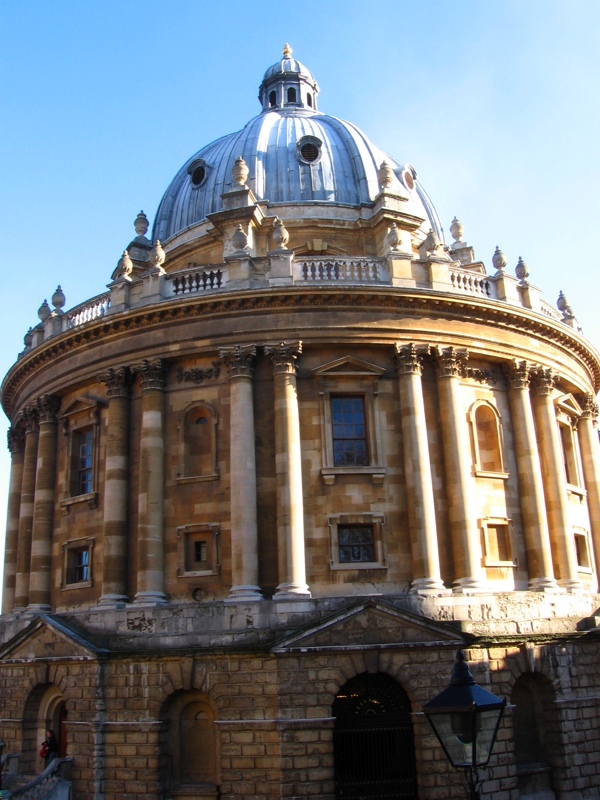
Or so said Bob Dylan. But that was about another Oxford. No, no; I'm talking about the Oxford northwest of London, home of 39 colleges, etc. Because I was just there, and because I do love the place, read this article about it in the NY Times. Here is a charming bit of trivia from the article:

Oxford is thick with pubs. What is this link between alcohol and academia, books and beer? One 20th-century student reputedly demanded a flagon of claret during his exams, having discovered an ancient rule in the University Statute Book entitling him to. The invigilator was able to annul the request because the student was improperly dressed: according to another statute, he should have been wearing a saber.

Thursday, February 08, 2007

to cleave or to cleave? the primates meeting in tanzania

Here is a very thoughtful piece on the upcoming primates' meeting from the Rev'd Canon Graham Kings. One of the article's strengths is that it gests at the polychromatic aspect of ECUSA and the Communion. I.e. that the situation is really much more complex, at both levels, than a mere division of "liberals" from "conservatives." Kings identifies "at least five...'streams' " within ECUSA.

Texanglican has some good comments on the piece. For my part, I don't think Kings lays quite enough stress on the need for something to be done NOW. Everyone knows that anything done now will necessarily be a stopgap measure. But such a measure is necessary. It is urgent. As Yeats put it:

...
Things fall apart; the centre cannot hold;
Mere anarchy is loosed upon the world,
The blood-dimmed tide is loosed, and everywhere
The ceremony of innocence is drowned;
The best lack all conviction, while the worst
Are full of passionate intensity.
Surely some revelation is at hand;
Surely the Second Coming is at hand.

I don't know about the Second Coming, but some definite relief, even if only provisional, for orthodox Anglicans in North America must be at hand. I agree that the Windsor and Covenant process(es) are the best hope for the Communion. And I understand that they will necessarily take some years to be devloped, submitted, and received by the Communion. That will be a process which, in order to have moral weight and authority, must involve Lambeth, etc. But between now and then, it is urgent that provision be made for the orthodox. And by "provision" I mean that orthodox dioceses must be (provisionally) relieved from the oversight of the Presiding Bishop, from the authority of 815, and indeed from the General Convention. The authority formerly exercised by the PB and the General Convention should be invested in the interim in either a (provisional) primate, or as Kings suggests, in a college of Windsor-compliant or (better) Network bishops. The latter (a college of bishops) is probably a better stopgap solution.

the presiding "bishop"

Friends, I have a new policy with regard to blogging about Schori and her public comments, such as her recent comments in USA Today that she sees that there are two versions of Christianity: on the one hand there's a version that's all about some nonsense called "atonement" wherein people believe "that Jesus died for our sins", and then there's another version (Schori's version) where you "talk about life" and "claim the joy."

Anyway, my new policy is this: I'm not going to blog about her. This (I hope and intend) will be my last post about Schori's blindness, etc. Its not that she shouldn't be talked about, shouldn't be refuted; its not that her apostasy shouldn't be named and decried. It should be. But I'll leave that to others. I just can't do it without cynicism, anger and depression. Its bad for my soul. So get your Schroi news elsewhere. I recommend Stand Firm. They do a wonderful job of staying on top of things and enumerating the various heresies, apostasies, etc. Its an important job. Seriously. I just can't do it. If I come to feel that I can do it, then I'll review this policy.

In the meantime, here's my advice: pray for Katharine. Often and fervently. Unite yourself in some small measure to our Lord's abnegation on behalf of Katharine; give up something for her. Fast for her. Pray that she will be granted conversion to the Gospel of Christ. Pray that she will know the forgiveness of sins that only comes through the suffering and death of the only Son of the Father, that the life of the Crucified will live and reign in her heart, to the glory of God.

Wednesday, February 07, 2007

adrienne von speyr...


...was a Swiss physician, mystic, and friend of Hans Urs von Balthasar, who saw von Speyr's life of prayer and suffering to be in some sense a formal key to his theology. Read about von Speyr's life here.

Von Balthasar wrote that shortly after her conversion, "a veritable cataract of mystical graces poured over Adrienne in a seemingly chaotic storm that whirled her in all directions at once. Graces in prayer above all: she was transported beyond all vocal prayer or self-directed meditation upon in order to be set down somewhere after an indeterminate time with new understanding, new love and new resolutions." This included "an increasingly open and intimate association with Mary…" Driving home one night shortly after her conversion, she saw a great light in front of the car and she heard a voice say: Tu vivra au ciel et sur lat terre (You shall live in heaven and on earth). This was "the key to all that was to follow" in her life.

my return

My dear friends, I have been out of the country for the last week or so. In England. Highlights include: Matins and Mass at Pusey House, listening to a talk on the place of theology in the university by Aidan Nichols, and getting lost in the wine cellar of St. John's College. It so happened that I spent the feast day of King Charles the Martyr, patron of this blog, in that Roundhead stronghold Cambridge. But right outside my room at St. John's was a statue of St. Charles and his queen, Henrietta Maria, so I felt ready for anything.

Thursday, February 01, 2007

International Philosophy


FYI: Beckenbauer was the German füssball captain and was regarded as "the Greatest German soccer player ever" in the 1970s.